
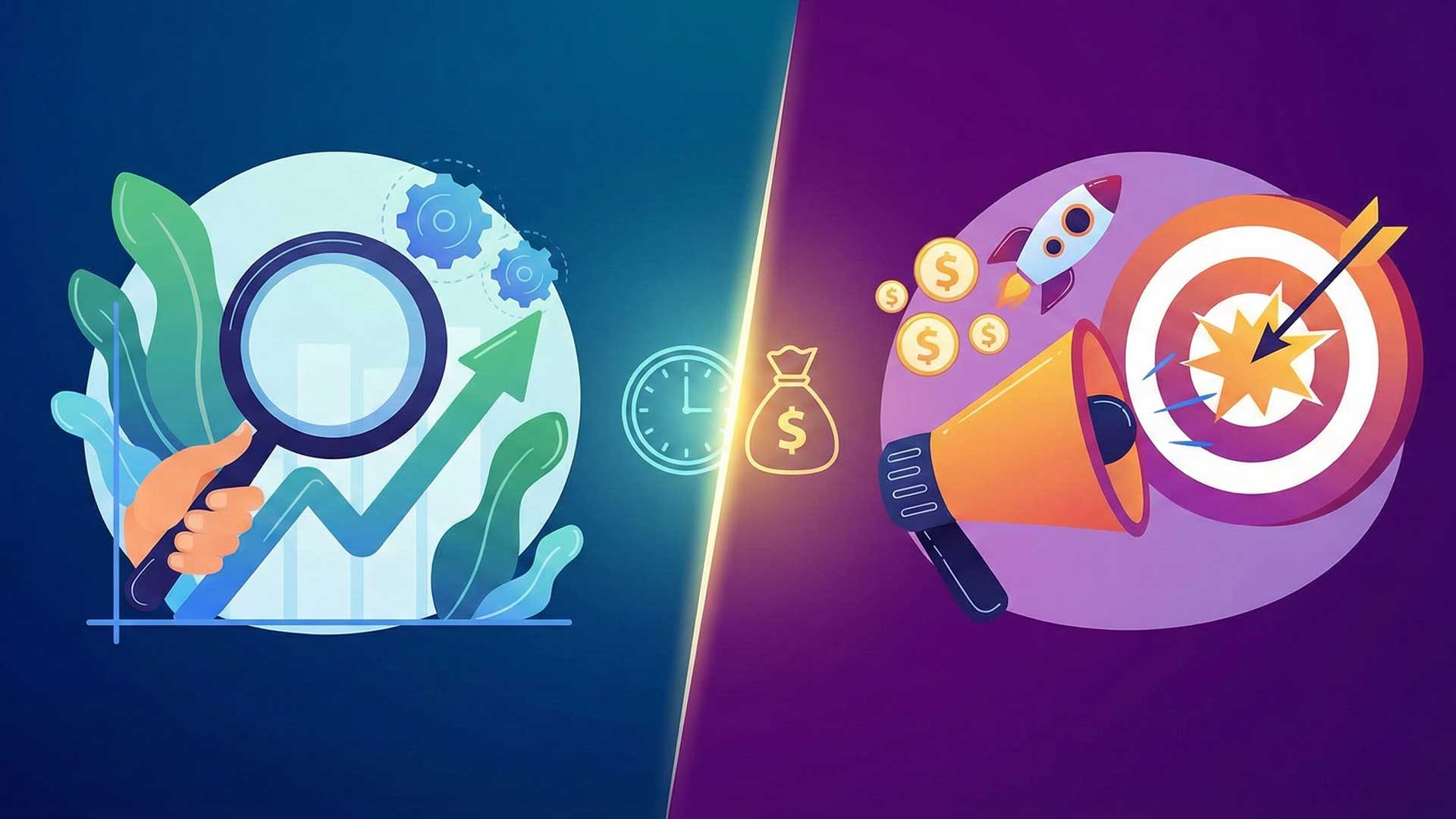
SEO vs. Paid Advertising: Which Digital Marketing Strategy Is Right for Your Business?

Imagine you need a new storefront. You have two options: You can buy a plot of land, spend months building a custom shop, and eventually own the property outright (SEO). Or, you can lease a prime retail space in the busiest mall in town, open for business tomorrow, but pay high rent every single month (Paid Advertising).
This is the fundamental dilemma facing every business owner stepping into the digital arena.
When you search for something on Google, you see two distinct types of results: the “Sponsored” listings at the top, and the organic listings below them. Both want your click, but they get there in very different ways.
Should you invest your marketing budget in Search Engine Optimization (SEO) or Search Engine Marketing (Paid Ads/PPC)? The answer isn’t always simple, and for many successful businesses, it’s not an “either/or” decision.
Let’s break down the pros, cons, costs, and best use cases for each strategy to help you decide which path is right for your business right now.
Contender 1: SEO (Search Engine Optimization)
The Long-Term Asset Builder
What is it?
SEO is the practice of optimizing your website and content so that search engines like Google deem it the best, most authoritative answer to a user’s query. The goal is to rank highly in the “organic” (non-paid) search results.
Think of SEO as building digital equity. It takes time, effort, and strategy, but once you earn a top spot, that traffic is essentially “free” and sustainable.
The Pros of SEO:
- Sustainability & Compounding Returns: Once you rank high for valuable keywords, you receive 24/7 traffic without paying for every click. The effort you put in today pays off for months or years.
- Trust and Credibility: Users often trust organic results more than paid ads. A high organic ranking signals that Google endorses your authority on a topic.
- Better Long-Term ROI: While the upfront cost of content creation and technical optimization can be high, the cost-per-acquisition over time is usually lower than paid ads because the traffic keeps flowing after the initial investment.
- Covers the Entire Funnel: Good SEO strategy uses blog posts to attract top-of-funnel researchers and product pages to convert bottom-of-funnel buyers.
The Cons of SEO:
- It’s Slow: This is the biggest drawback. It can take 3 to 12 months to see significant movement in rankings, especially in competitive industries. It is a marathon, not a sprint.
- No Guarantees: You are at the mercy of Google’s algorithm, which changes thousands of times a year. A strategy that works today might need tweaking tomorrow.
- It’s Resource Intensive: Good SEO requires high-quality content writing, technical website skills, and ongoing link-building efforts. It’s not “set it and forget it.”
Best For: Businesses with a long-term vision, limited immediate ad budgets, those looking to build brand authority, and those in industries where trust is paramount (e.g., healthcare, finance).
Contender 2: Paid Advertising (PPC)
The Instant Traffic Faucet
What is it?
Paid advertising involves paying a platform (like Google Ads, Meta/Facebook, LinkedIn) to display your message to a specific audience. The most common form is Pay-Per-Click (PPC), where you bid on keywords and pay a fee every time someone clicks your ad.
Think of PPC like a water faucet. You turn it on (pay), and the leads flow instantly. You turn it off (stop paying), and the leads dry up immediately.
The Pros of Paid Advertising:
- Speed: You can set up a campaign today and start getting calls or sales tomorrow. It is the fastest way to get visibility.
- Laser-Precise Targeting: You aren’t just hoping people find you. You can target by exact keywords, demographics, location, interests, and even “remarket” to people who visited your site but didn’t buy.
- Testing and Agility: Want to know if a new product messaging works? Run ads for a week. The data is immediate, allowing you to pivot quickly.
- Dominance Above the Fold: Paid ads appear at the very top of mobile and desktop screens, pushing organic results down.
The Cons of Paid Advertising:
- It gets expensive quickly: In competitive industries (like insurance or law), a single click can cost upwards of $50. If you don’t have a high-converting website, you will burn cash fast.
- The “Rental” Trap: You are renting traffic. You build zero long-term equity. The moment your budget runs out, your visibility disappears.
- Ad Fatigue and Skepticism: Many users actively ignore ads (banner blindness) or use ad blockers.
Best For: New product launches, time-sensitive promotions, businesses that need immediate leads to survive, and testing new markets before investing in SEO.
Head-to-Head Comparison Summary
| Feature | SEO (Organic) | Paid Advertising (PPC) |
| Time to Results | Slow (Months) | Instant (Hours/Days) |
| Cost Structure | High upfront effort, lower cost over time. | You pay for every single click. |
| Sustainability | High. Traffic continues after effort stops. | None. Traffic stops when payment stops. |
| Traffic Volume | Grows slowly over time. | Scalable instantly based on budget. |
| Trust Factor | High credibility with users. | Lower (seen as advertisements). |
| Control | Low (at mercy of algorithms). | High (you control copy, landing page, targeting). |
The Decision Framework: How to Choose
Still stuck? Use this framework to decide where to put your first dollar.
1. What is your timeline?
- Need sales next week to keep the lights on? Choose Paid Ads.
- Building a foundation for next year’s growth? Choose SEO.
2. What is your budget situation?
- Have more time than cash? Invest sweat equity into creating great SEO content.
- Have marketing capital but no time to wait? Invest in paid media to buy immediate visibility.
3. How unique is your product?
- If nobody knows your type of product exists, they won’t be searching for it on Google. You might need Paid Social Ads (Facebook/Instagram) to generate demand.
- If everyone is already searching for what you sell, SEO is crucial to get in front of that existing demand.
4. How is your website’s conversion rate?
- Don’t run paid ads to a bad website. It’s like pouring water into a leaky bucket. Fix your site’s user experience (UX) first, perhaps starting with SEO to test the waters before spending ad money.
The Winning Strategy: The Hybrid Approach
The truth is, the most successful businesses rarely choose just one. They understand that SEO and Paid Ads work best when they work together.
- Use PPC to test for SEO: Run ads on different keywords to see which ones actually convert into sales. Once you find the winners, invest your SEO efforts into ranking organically for those specific terms.
- Dominate the SERP: For your most critical brand keywords, you should aim to have both a paid ad at the top and the #1 organic ranking below it. This signals massive authority to the user and boxes out competitors.
- Remarketing: Use SEO to bring free traffic to your blog. Then, use paid ads to “retarget” those visitors on social media with a special offer to bring them back to buy.
Conclusion
SEO is your savings account; it builds wealth over time. Paid advertising is your debit card; it’s instant cash flow for immediate needs.
Don’t ask “Which one is better?” Ask “Which one does my business need right now?” Often, the smartest answer is to start building your long-term SEO foundation today, while using strategic paid advertising to keep the leads flowing in the meantime.
Frequently Asked Questions (FAQs)
1. Which strategy is better for a small budget? If you have more time than money, SEO is the better starting point. You can create content and optimize your site yourself without spending cash on clicks. However, if you have a small budget but need immediate sales to reinvest, a highly targeted PPC campaign (focused on just 2-3 high-intent keywords) can work, provided you monitor it closely to avoid waste.
2. Does paying for Google Ads improve my organic SEO rankings? Directly? No. Google keeps paid and organic algorithms completely separate. Spending thousands on ads won’t “bribe” Google into ranking your website higher organically. However, indirect benefits exist: ads send traffic to your site, increasing brand awareness and potentially leading to organic searches or backlinks later.
3. Can I do SEO myself, or do I need an agency? You can certainly handle the basics—writing good content, using correct keywords, and ensuring your site loads fast. However, technical SEO (site architecture, schema markup) and off-page SEO (link building) can be complex. As your business grows, hiring experts like M4YOURS IT ensures you don’t miss technical opportunities that could double your traffic.
4. Why are my Google Ads costs (CPC) going up? PPC runs on an auction system. If more competitors bid on your keywords, the price goes up. Additionally, if your “Quality Score” is low (meaning your ad or landing page isn’t relevant to the user), Google charges you a penalty premium. Improving your landing page experience is the best way to lower costs.
5. Once I rank #1 on Google with SEO, can I stop doing it? No. SEO is like a fitness routine, not a one-time surgery. If you stop creating content and updating your site, your “freshness” score drops. Meanwhile, your competitors are constantly trying to outrank you. To stay at #1, you must defend your position with ongoing optimization.
6. Is “PPC” the same as “Facebook Ads”? Technically, they are both paid advertising, but the intent is different. PPC (Google Ads) captures demand—people actively searching for “plumber near me.” Social Ads (Facebook/Instagram) generate interest—interrupting people scrolling their feed to show them something they might like. PPC is usually better for immediate sales; Social is great for brand awareness.
7. How long does it really take to see SEO results? For a brand new website, expect 6 to 12 months to see significant traffic. For an established site with some history, you might see improvements in 3 to 4 months. It depends on how competitive your industry is. If you are a lawyer in New York, it takes longer than if you are a baker in a small town.
8. What happens to my traffic if I stop paying for Ads? It drops to zero instantly. This is the main risk of relying only on paid ads. If your credit card expires or you pause the campaign, your visibility vanishes immediately. This is why we recommend building SEO in the background so you eventually have a safety net of free traffic.
9. Should I bid on my own brand name in Google Ads? Yes. Even if you rank #1 organically for your brand name, competitors can bid on your name and show their ads above your website. Bidding on your own brand is usually very cheap and ensures you control the top spot on the page, preventing competitors from stealing your potential clients.
10. I’m overwhelmed. How do I choose the right mix for my business? You don’t have to guess. At M4YOURS IT, we perform a “Digital Opportunity Audit.” We look at your competitors, your budget, and your goals to build a custom roadmap—whether that’s 100% SEO, 100% Ads, or a strategic hybrid. [Contact us today] to stop wasting budget and start seeing results.